
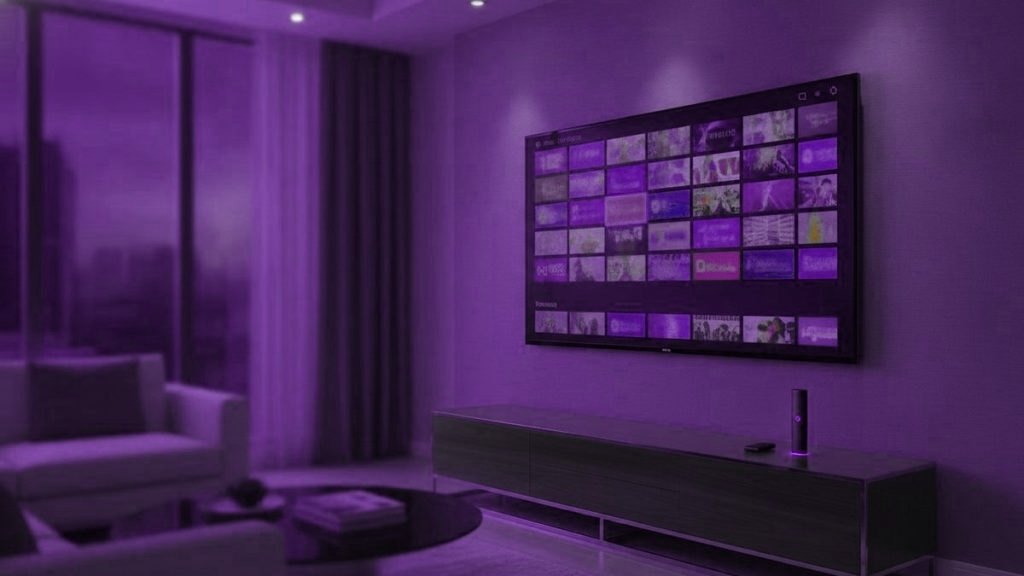
IPTV means television that arrives through your internet connection rather than through an aerial, a satellite dish or a cable in the street. Nothing else about it is unusual. A channel reaches your screen the way a video call reaches your phone: as data, on request, from a computer somewhere else. This page takes that one idea and walks it out to every practical consequence, so that by the end you can read a provider’s website and know what each line means.
The shortest true answer
Old-fashioned broadcasting throws every channel out at once and lets your television catch the one you want. IPTV does the opposite: it sends one channel to one viewer, only when that viewer asks. Almost every difference you will notice comes from that reversal.
The word, taken apart
IPTV is short for internet protocol television. The middle two words are the part worth explaining. A protocol is an agreed set of rules for moving information between computers, and internet protocol is the particular set of rules the whole internet already runs on. Your email, your bank app and your video calls all travel that way. IPTV is television using the same rules.
So the name is not describing a new invention. It is describing where television has been moved to. That is why you will see the term used for very different products: a phone company selling TV down its own fiber line, a licensed live-TV app, and an independent subscription like this one all move television over internet protocol, and all three are correctly called IPTV. The technology is shared. What differs is who runs the servers and what they are allowed to carry, which we come back to at the end.
Three parties have to exist before a picture appears
It helps to know who is involved, because when something goes wrong the fix nearly always belongs to one of them and not the others.
- A source. Somewhere a channel is being produced and put out. That is the broadcaster, and nothing on your side changes what they send.
- A provider with servers. A provider receives channels, converts each one into a form that travels over the internet, and keeps them on servers ready to be sent out. When you pay for a subscription, this is what you are paying for: capacity on those servers and an account that is allowed to use it.
- You, with a screen and a player. A small free app on your television or stick holds your account details, asks the server for a channel, and paints the result on the screen.
Two of those three are out of your hands. The third is entirely yours, and it is the one people set up wrong on the first evening, usually by expecting the app to come with channels already inside it.
The subscription is the product; the app is an empty frame
This is the single largest source of confusion for a new buyer, so it is worth being blunt about it. A player app such as IPTV Smarters Pro or TiViMate contains no television at all. Install it and it shows you a login screen and nothing else. It is a frame waiting for a picture.
What fills it is a set of credentials, which is the industry word for the three pieces of text a provider gives you: a username, a password and a server address. You type those in once, the app calls the server, and the channel list, the movie library and the program guide all arrive together. The credentials are the thing you bought. The app is free and interchangeable, which is why the same subscription can run on a television in one room and a phone in another without buying anything twice.
The alternative arrangement you will see mentioned is an M3U playlist, which is a single long web address that carries the whole channel list inside it. Older apps accept only that. Either way, the principle is identical: one piece of text unlocks everything, and losing it is the only thing that locks you out.
What happens in the two seconds after you press a channel
Understanding this sequence explains nearly every complaint anyone has about IPTV, so it is worth thirty seconds of your attention.
-
The app asks
Your player opens a connection to the provider’s server and names the channel you selected.
-
The server starts cutting
The channel is sent to you and to nobody else, chopped into numbered pieces a few seconds long.
-
The app builds a small reserve
Rather than showing the first piece immediately, the player collects several and holds them. That reserve is called the buffer.
-
Playback begins, and refilling continues
You watch from the reserve while the app quietly fetches the next pieces behind it.
Now the useful part. When your connection dips or the server is busy, the reserve drains faster than it refills. The moment it empties, the picture stops and a spinning circle appears. That is all buffering is: the player waiting for pieces that have not arrived. It is not the channel breaking, and it is very often not the provider either. A television on weak Wi-Fi at the far end of a house produces exactly the same symptom as an overloaded server, which is why the first thing to try is a cable from the router to the television.
Four things have to be true in your home
Nothing here needs to be bought new by most households.
A connection that stays steady. Around 10 Mbps carries one high-definition channel and around 25 Mbps carries one in 4K. Add them up for every screen that will be playing at the same moment. The figure printed on your broadband bill is a best case; what matters is what the line does at nine in the evening when the whole street is online.
Something that runs apps. A Samsung or LG television from 2016 onward, a Fire TV Stick, any Android TV device, an Apple TV, a laptop, a phone, or a dedicated box such as a Formuler or a MAG. Our setup guides cover each of these one screen at a time.
A player app. Free, from whichever store your device already uses. Which one is right is decided by the hardware rather than by taste, and the apps guide matches them up.
A subscription. The only part that costs money. VOCOIPTV plans start at $15 for one month on one screen and $69 for a full year, and the full table sits on the pricing page.
Five things IPTV is not
Ruling things out is often faster than defining them.
- It is not a piece of hardware. There is no VOCOIPTV box in a shop. You are buying access, not an object.
- It is not an aerial or dish replacement in the physical sense. Nothing is installed on your roof or drilled through a wall, and nobody visits.
- It is not Netflix with more channels. A subscription platform sells you a library it owns and commissions. An IPTV line hands you live channels running to a schedule, plus a separate library of 120,000+ films and series. If a specific original series is the reason someone in your house pays for a platform, that series will not appear here.
- It is not a VPN, and it does not need one. A VPN is a privacy tool for hiding your traffic on a network you do not control, such as hotel Wi-Fi. It is unrelated to whether television plays.
- It is not automatic. Nothing renews by itself here, and no card is kept on file. When a term ends it stops, and you decide whether to start another.
The words you will meet in the first ten minutes
Provider websites use a small private vocabulary and rarely explain it. These six cover most of it, and the full list is in the IPTV glossary.
| Word | What it actually means |
|---|---|
| Line | One subscription account. A provider saying “your line expires” means your account does. |
| Connection | One screen playing at the same time. A two-connection plan lets two screens play at once; you may install the login on more devices than that. |
| EPG | The program guide: the grid showing what is on now and next. |
| VOD | Video on demand, meaning the films and series library you browse rather than the live channels. |
| Catch-up | A short archive of programs that already went out on a live channel, usually kept for a few days. |
| Bitrate | How much data per second a channel is given. It decides how good the picture looks far more than the 4K label does. |
What genuinely changes about the way you watch
Three things surprise people in the first week, and none of them are faults.
The first is scale. A cable package offers a few hundred channels and a curated feel. A line carrying 25,000+ channels from 60+ countries feels closer to a phone book. Nobody scrolls it end to end. The practical approach is to spend the first evening building a list of favorites and then ignore the rest, which every player app supports.
The second is that channels are often listed more than once, in 4K, FHD and HD versions. That is not a mistake. The lower versions need less of your connection, and switching to one of them is the standard fix when a particular channel struggles on your line.
The third is that the program guide is a separate feed from the channels. If the guide looks empty for a few minutes after setup, it is still being downloaded, and it fills in on its own.
The legality question, stated honestly
The technology carries no legal status of its own, in the same way that a web browser carries none. What can be lawful or unlawful is the distribution of particular channels, and that depends on rights agreements held by the provider rather than on anything the viewer does. Licensed live-TV services exist and publish their agreements. Independent providers, VOCOIPTV included, do not publish licensing agreements, and we are not going to tell you that we are authorized by any broadcaster. The legality guide lays out who the law actually targets, what varies between countries, and what a buyer can reasonably weigh up. Read it before you pay anyone, including us.
Finding out whether it works on your line, at no cost
None of the above tells you the only thing that matters, which is how it behaves on your connection, in your house, at the hour you watch. That is a measurement, not an opinion, and it takes one evening.
A 24-hour free trial opens a real account with the full 25,000+ channel list. Message us on WhatsApp at +212 663 813 479, say which device you have, and the login arrives in the same chat, usually in under 15 minutes. Put your three or four must-have channels on at the busiest time you would normally be watching, and watch them for a while rather than flicking. If it holds, it will hold when you pay. If it does not, you have spent nothing and learned something specific about your own line.
After that, the first paid term can be a single month at $15, and there is a 7-day money-back window behind it. There is no reason to commit to a year to find out whether a service suits you.
Questions readers ask about this
What am I actually buying when I buy an IPTV subscription?
You are buying an account on a provider's servers, handed to you as three pieces of text: a username, a password and a server address. Nothing is shipped and nothing is installed in your home. You type those details into a free player app on a screen you already own, and the channel list, the film library and the program guide arrive from the server. When the term you paid for runs out, the account stops working until you start another one.
Does the player app come with channels already in it?
No, and this is where most first evenings go wrong. Apps such as IPTV Smarters Pro and TiViMate are empty frames. Installed on their own they show a login screen and nothing else, because they hold no television of their own. They fill up the moment you enter the username, password and server address from a subscription. The app is free and replaceable; the account details are the part that costs money and the part you should keep safe.
How fast does my internet connection need to be?
Allow roughly 10 Mbps for one channel in high definition and roughly 25 Mbps for one in 4K, then add those figures together for every screen that will be playing at the same moment. Steadiness matters more than the headline number on your bill, because the player only holds a few seconds of video in reserve. A cable from the router to the main television removes more stuttering than paying for a faster package usually does.
Can one subscription run on the television and on a phone?
Install it on as many devices as you like. What the plan limits is how many screens can play at the same moment, which providers call connections. A one-connection plan is fine if only one screen is ever on; if a television downstairs and a tablet in the kitchen run together, that is two. VOCOIPTV sells plans for one, two, three or five screens at a time, and you can move up later without starting again.
How is this different from the streaming apps I already pay for?
A streaming platform sells you a library it owns, organized as things to browse. An IPTV line hands you live channels running to a schedule, with a program guide, plus a separate library of films and series alongside them. Live sport and rolling news from other countries are the clearest difference. The original series a platform commissions for itself stay exclusive to that platform, so if one of those is why somebody in your home subscribes, keep that subscription.
Why do the free channel lists people share stop working?
A free list is usually one account being passed around by thousands of people at once. The server either blocks it or cannot serve everyone, so channels die within days and whatever survives freezes during anything popular. A paid subscription is a private account on servers sized for peak hours, and that capacity is the actual product. The honest way to judge whether a paid one is worth it on your line is to run a trial during a busy evening.
Still deciding? Ask before you pay.
Send us a message and a person replies. Tell us what television or box you have and we will say plainly whether it will work, before any money changes hands.
More on the same subject
IPTV Words, Explained in the Order You Meet Them
Sellers write 1 connection, Xtream or M3U, EPG included and explain none of it. Every word you will meet, defined without leaning…
September 19, 2026IPTV vs Cable: What Changes, From Signing Up to Leaving
Lining up channel counts against monthly prices misses most of what differs, because one is a utility installed at an address and…
September 19, 2026IPTV vs Streaming Apps: A Schedule Against a Catalog
Both words have drifted from their original meanings, which is why comparisons of them confuse people. The strict definitions, the everyday ones,…